


1. Overview
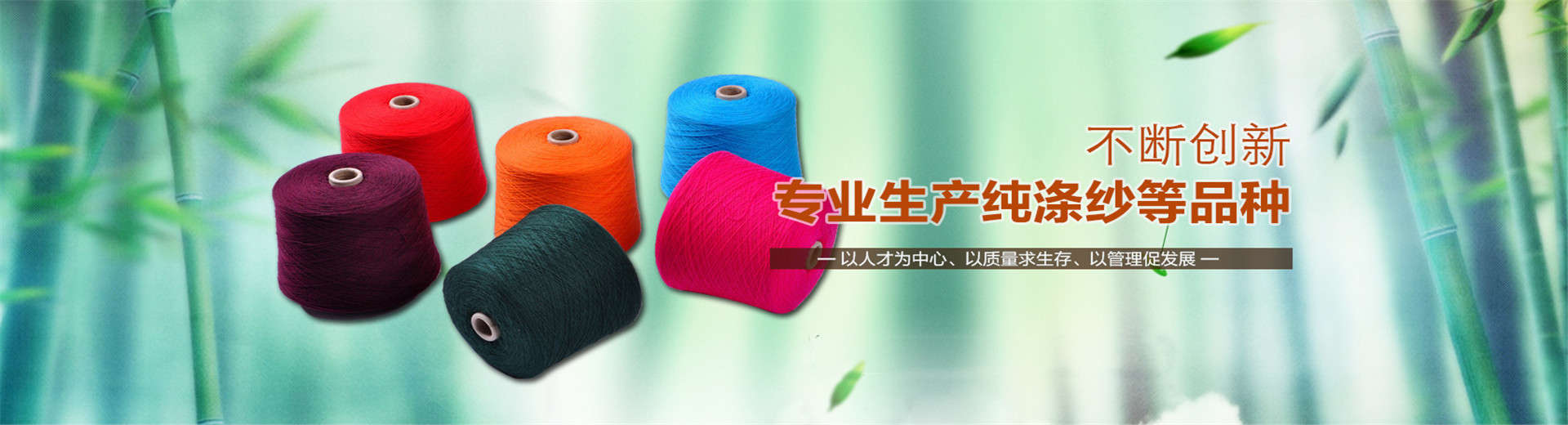
The yarns made from chemical fibers (acrylic fiber, chlorine fiber, polyester fiber, polyamide fiber, vinylon, etc.) through spinning process are collectively referred to as chemical fiber yarns.
2. Use
Chemical fiber yarns are widely used in the knitting, weaving, blanket and carpet industries.
3. Main producing countries and regions
Japan, USA, Italy, China, Taiwan, etc.
4 Type
There are many kinds of chemical fiber yarn, generally: acrylic normal yarn, acrylic fiber bulk yarn, polyester yarn, polyamide yarn, vinylon yarn, chloramide yarn, chemical fiber blended yarn and so on.5. Specification and quality
The specifications of chemical fiber yarns vary according to their USES. There are pure and blended yarns, cotton and synthetic yarns, knitted and synthetic yarns, blankets and carpets. There are also cotton yarns and wool yarns.
General specifications of cotton yarn: 40, 42, 60 Ne single yarn and 20, 25, 31, 32, 36 NE double yarn, knitting acrylic bulk yarn: 13, 16, 20, 26 NE.
6. Performance:
(1) number of chemical fiber yarn: the size of chemical fiber yarn is expressed by metric number, large number means chemical fiber yarn fine, small number means chemical fiber thick. The metric count is the number of 1kg of synthetic yarn in kilometers. If the weight of 1kg chemical fiber yarn length of 18000m is 18 yarn.
(2) chemical twist: the twist of chemical yarn refers to the number of turns per unit length. Twist is twist, there are two twist direction, one is "S" twist, the other is "Z" twist, twist is usually: twist /m, different count, the twist is different, in order to compare different count of twist, "twist coefficient" concept is commonly used.
Chemical fiber yarn twist on quality: the influence of chemical fiber yarn twist size, on the chemical fiber yarn strength, flexibility, scalability has great influence, within a certain range of the increase of twist, strength increase, if exceed limit increase of twist, it will make its intensity is abate, chemical fiber yarn twist small, soft, and the intensity of down.
(3) strength and elongation of the chemical fiber yarn: the strength of the chemical fiber yarn has a close relationship with the fabric's fastness and production efficiency. The strength and elongation of chemical fiber yarns vary according to their raw materials, processing degree and fiber arrangement. The raw materials are of good quality, the fibers are neatly arranged, the twist is appropriate, and the strength and elasticity of the chemical fibers are also good. Chemical fiber yarn strength test is divided into two kinds, one is the strength of single yarn, one is the strength of wisp yarn.
(4) moisture recovery of chemical fiber yarn: polyester yarn 0.4%, acrylic yarn 2%, polyamide yarn 4.5%, vinylon yarn 5%, polypropylene yarn 0%, chloramide yarn 0%.
(5) appearance defect of chemical fiber yarn: the appearance defect of chemical fiber yarn has a great influence on textile quality, not only increasing weaving difficulties, but also affecting the appearance and dyeing uniformity of the fabric. Therefore, when evaluating the quality of chemical fiber yarn, the appearance defect should also be checked. Common defects affect yarn evenness, smoothness and pollution.
OUR PRODUCT
CONTACT US
扫一扫手机访问
Tel/Fax:0086-51085164682 Mobile:0086-13814238051
Email:morganwei@foxmail.com Post Code:214000
Headquarters :U Valley Industrial Park, Wuxi,Jiangsu China
International department: 25# Jinghongyuan binhu district,Wuxi,Jiangsu China
CHEMICAL FIBER
POLYESTER TOW/TOPS
ALL KIND OF YARN /BLEND YARN
POLYSTER /NYLON DTY&FDY&HTY&HOY
Copyright © 2018 KING INVESTMENT MANAGEMENT CO,LTD